Tag Archives: How it’s made
How It’s Made – Darts

Have a look at this. The first 40 seconds are a bit cheesy, but the rest is fascinating. I'll never look at a set cheap brass darts in the same light again.
I think the yellow flights in the film are the R4X type that I use because you can see some small black text at one end of them. I'd love to be able to use the aluminium stems they've shown, but they always seem to need constant replacement.
How It’s Made PENCIL

One of the oldest and most widely used writing utensils, the pencil originated in pre-historic times when chalky rocks and charred sticks were used to draw on surfaces as varied as animal hides and cave walls. The Greeks and Romans used flat pieces of lead to draw faint lines on papyrus, but it was not until the late 1400s that the earliest direct ancestor of today's pencil was developed. About one hundred years later graphite, a common mineral occurring as soft, lustrous veins in rocks, was discovered near Borrowdale in northwestern England. The Borrowdale mine supplied Europe with graphite for several hundred years; however, because people could not then differentiate between graphite and lead, they referred to the former as "black lead." Cut into rods or strips, graphite was heavily wrapped in twine to provide strength and a comfortable handle. The finished product, called a lead pencil, was quite popular. In the late sixteenth century, a method for gluing strips of wood around graphite was discovered in Germany, and the modern pencil began to take form. In 1779, scientists determined that the material they had previously thought was lead was actually a form of microcrystalline carbon that they named graphite (from the Greek "graphein" meaning "to write"). Graphite is one of the three natural forms of pure carbon—the others are coal and diamond.
In the late eighteenth century the Borrowdale mine was depleted, and, as graphite was now less plentiful, other materials had to be mixed with it to create pencils. A Frenchman chemist, Nicolas Jacques Conte, discovered that when powdered graphite, powdered clay, and water were mixed, molded, and baked, the finished product wrote as smoothly as pure graphite. Conte also discovered that a harder or softer writing core could be produced by varying the proportion of clay and graphite—the more graphite, the blacker and softer the pencil. In 1839, Lothar von Faber of Germany developed a method of making graphite paste into rods of the same thickness. He later invented a machine to cut and groove the pencil wood. Following the depletion of the once-abundant graphite source at Borrowdale, other graphite mines were gradually established around the world.
A number of these mines were set up in the United States, and the first American pencils were manufactured in 1812, after the War of 1812 ended English imports. William Monroe, a cabinet maker in Concord, Massachusetts, invented a machine that cut and grooved wood slats precisely enough to make pencils. Around that time, American inventor Joseph Dixon developed a method of cutting single cedar cylinders in half, placing the graphite core in one of the halves, and then gluing the two halves back together. In 1861, Eberhard Faber built the United States' first pencil-making factory in New York City.
Today, the hardness of a pencil is designated by numbers or letters. Most manufacturers use the numbers 1 to 4, with 1 being the softest and making the darkest mark. Number 2 pencils (medium soft) are used for normal writing. Pencils are also sometimes graded by letters, from 6B, the softest, to 9H, the hardest. The idea of attaching an eraser to a pencil is traced to Hyman W. Lipman, an American whose 1858 U.S. patent was bought by Joseph Rechendorfer in 1872 for a reported $100,000.
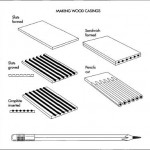
The first step in pencil manufacture involves making the graphite core. One method of doing this is extrusion, in which the graphite mixture is forced through a die opening of the proper size.
In addition to the conventional wood pencil, a number of other pencils are widely used. In the early 1880s, the search for a pencil that didn't require sharpening led to the invention of what has variously been termed the automatic, propelling, or repeating pencil. These instruments have a metal or plastic case and use leads similar to those found in wood cased pencils. The lead, lodged in a metal spiral inside the case, is held in place by a rod with a metal stud fastened to it. When the cap is twisted, the rod and stud move downward in the spiral, forcing the lead toward the point. The early twentieth century saw the development of colored pencils in which the graphite core was replaced by a combination of pigments or dyes and a binder. Today, colored pencils are available in more than 70 colors, with 7 different yellows and 12 different blues. However, the cedar-casing lead pencil—manufactured at a pace of 6 billion per year in 40 different countries—continues to outsell all of its competitors, including the ballpoint pen.
How its made – Trombones

The Trombone is a member of the brass family. It plays notes that are lower than the french horn, though not as low as the tuba. The tone of the trombone is rich and brilliant. If you were to unwind the trombone, the total length of the tubing would be about 9 feet!
History
Trombones have been around for more than 500 years. In fact they were around when Columbus was busy sailing the ocean blue in 1492. Trombones, originally called sackbuts, are very much like the modern instrument. The word sackbut may possibly come from the French word 'sacquer', which means 'to draw out'.
The Trombone Family
The modern symphony orchestra is made up of two or three tenor trombones and one bass trombone. The alto trombone, which plays the highest sounds, completes the trombone family.
How It's Played
While most brass instruments use valves to play different pitches, the trombone uses a slide. The slide may make it look different, though the way it works is basically the same as valved brass instruments. When the trombonist plays, he/she moves the slide back and forth to select one of 7 different lengths of tubing. This is how they change the pitch. The rest of the brass family instruments select a different length of tubing by simply pressing down a different set of valves.
Fun Facts
Beethoven was the first composer to write a trombone part for a symphony. He included one in his Fifth Symphony.
Trombones are made of brass, a metal made of copper and zinc. Both of these metals are found in vitamins. This means that during your life you may eat an entire trombone – and it would be good for you!